TEENAGE SEX AND DEATH AT CAMP MIASMA (2026) REVIEW
Joshua Lightfoot
8/27/26
112 minutes
Warning: Minor Spoilers
Moviegoers who knowingly buy a ticket for a movie titled Teenage Sex and Death at Camp Miasma are guaranteed to get the 3 things the title promises. Firstly, there is sex. Lots of it. It’s loud and proud while also feeling awkward and unafraid. Second thing, we got death. There are campers being killed even within the minute the movie begins. Lastly, there is a camp, and it is indeed named Camp Miasma. You are promised those things, and you get them. But it may not be in a way you would expect. You’re expecting a slasher movie. Right? It is. But it goes so much further than that. I’m seeing this movie described in all kinds of different wild ways I’ve never even heard before. A “satirical surrealist psychological slasher”, a “psychosexual meta-horror comedy”, or how about a “steamy queer romantic slasher”. That last one is my favorite. If that isn’t your thing, you can stop reading now.
In this “steamy queer romantic slasher”, a young and promising filmmaker named Kris Williams (played by Hannah Einbinder) is hired to direct a reboot of a long running 80’s horror franchise, Camp Miasma. A montage of clips and articles give a pretty good idea of its rise, fall, popularity, and cult status. The films are best described as a cross between Sleepaway Camp and Friday the 13th. In Camp Miasma, a killer named “Little Death” (played by Jack Haven) stalks the camping grounds looking for horny teenagers to slaughter. Little Death was raised multigender by the parents during childhood and was murdered after being drowned by bullies in the camp lake. The ghost of Little Death rises from that same frozen lake every year in a white HVAC hazmat suit, an oversized square metal vent over its head, and armed with a long double-sided, double-bladed sharp spear.
The popularity of the Camp Miasma franchise dropped after a string of unsatisfying sequels, diminishing returns, and the cancel culture boom of 2020. Our reboot filmmaker, Kris, is instructed to make this new Camp Miasma reboot far less problematic to appease and not offend modern audiences. Despite its homophobic history and Kris being queer herself, she is still a life-long, die-hard fan of Camp Miasma. This is the thing that actually played a big part in her queer awakening during childhood. Not wanting to let the original movie lore to die outright, she plans a visit to the home of actress Billy Presley (played by Gillian Anderson). Billy played the “Final Girl” in the first Camp Miasma film.
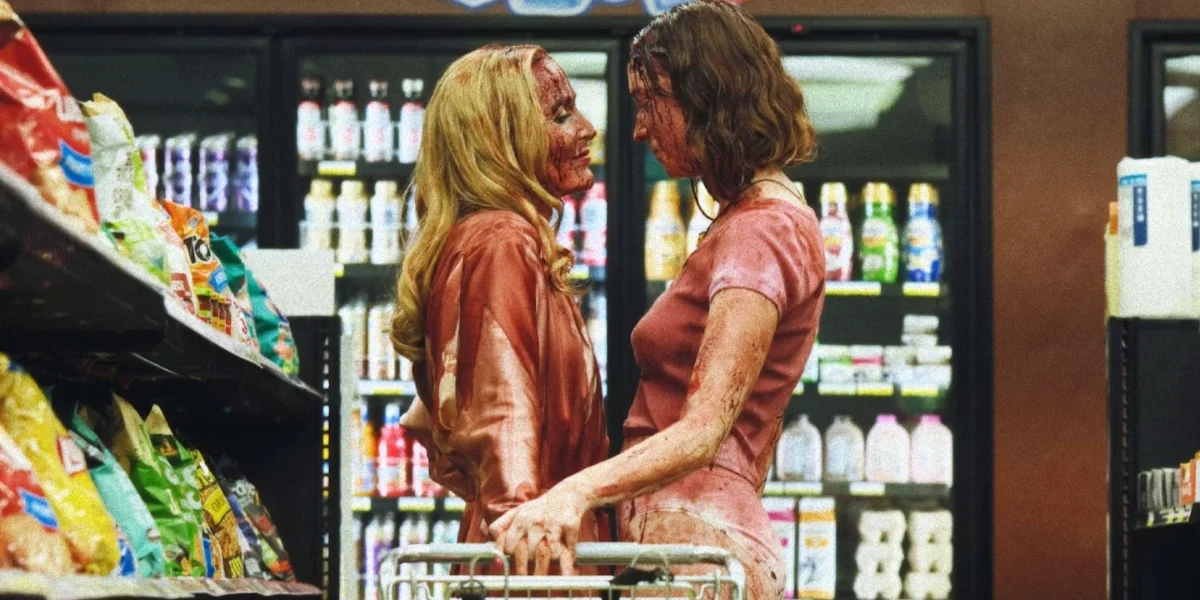
The plan for Kris is to develop a working relationship with Billy, get a feel for the new movie, and reprise her role in the new film. But Billy is a recluse and hasn’t acted in years. Think of her as Shelley Duvall in her later years. Billy also strangely lives on the actual campgrounds the Camp Miasma series was filmed. Things start to go off the rails following a screening of the first movie between the two women. There are deeply personal confessions about sex, sexual assault, sexual fantasies, awkward sex, being bad at sex, good sex, etc. If you ever wanted to see Skully from The X-Files pleasure someone with great satisfaction, your prayers have been answered. An organism then spawns “Little Death” from the nearby lake. We are now in the movie within the movie.
I’m reminded of 2 other films here that may have borrowed inspiration. The first one being Anguish (1987), where we, the audience, are watching an audience watch a movie. We got 2 movies for the price of one with Anguish. The same could be said for Teenage Sex and Death at Camp Miasma. We take a break from the story we have been following to watch another film that the characters have been admiring. The 2nd inspiration is Wes Craven’s New Nightmare (1994). Filmmakers making a new Freddy Krueger movie are living the real-life nightmare, just like our 2 leads at Camp Miasma.
It’s clear that director Jane Schoenbrun is a massive horror fanatic. Sometimes I feel we get hit with references a bit too often. A scene with a phone call to an agent (played by Sarah Sherman) unloads an obnoxious number of name-drops and actors to the point where I’m saying “Ok, I get it. You like horror movies”. But a reference to the 1981 slasher flick The Burning in the manor it’s delivered got a pretty good laugh out of me. It feels weird that Sleepaway Camp and Camp Miasma exist in the same universe when both movies share such a similar controversial twist. Friday the 13th is curiously never mentioned by name despite being an obvious inspiration. Cleverly, fake Camp Miasma VHS covers are seen that you know were heavily inspired by the Friday the 13th franchise posters. A DVD of Camp Miasma VI: A New Beginning that Kris picks up from the store has artwork that is a definite nod to the Friday the 13th Deluxe Edition DVD line from 2009. I much enjoy little things like this.
The standout performance is easily Gillian Anderson. Playing a former actress turned recluse who is not only able to suck her visitor into a bizarre fantasy world, but the viewers as well. Her character as a retired performer is parallel to that of Norma Desmond in Sunset Boulevard (1950). I don’t see many films on Anderson’s resume. I know of her role in The Last King of Scottland (2006) and her more recent job in Tron Ares (2025). Her massive film gap screams an Amy Madigan type comeback for me. I’m no TV expert, but I know that’s where she has been most comfortable in her career, including an Emmy win for playing Margaret Thatcher in The Crown (2016). I doubt we’ll see an Oscar nomination here, but I do think it should be part of at least a conversation.
As for the rest of the cast, it’s a little hard to critique Jack Haven as Little Death since a good chunk of the performance involves a metal box on their head. There is one very memorable scene with Little Death that mixes a banger needle drop with Darren Aaronfsky’s SnorriCam shot. This is a sequence that would get rewound and replayed the most if available on a VHS. I’m not familiar with Hannah Einbinder’s work, but I see she does mostly TV and stand-up. She fits the role as an enthusiastic rising filmmaker quite well. Dumping Raisinets in her bucket of popcorn as a snack while watching a slasher movie in a hotel room was more than enough to win me over early. My only gripe with the cast is actor Dylan Baker as a Studio Executive, whose only 1 scene is in a zoom call meeting and likely took place in his own living room. Hate to see his talent underutilized in such a way.
What I admire mostis Jane Schoenbrun’s ability to take her knowledge of horror and make something that feels rather personal and meaningful. Something much deeper than a Love Letter like The Cabin in the Woods (2011). It certainly felt like a rare and uncommon experience. There are many feelings and themes on display here. After taking it all in, it’s a puzzle trying to understand all of it. I’m sure there are viewers that will leave feeling confused once it’s over, but experiences like this are ones we don’t get all too often. Jane’s previous film, I Saw the TV Glow (2024), did show a promising new voice for the genre. However, I thought that film was all vibes and no narrative, at least in my opinion. I enjoyed Teenage Sex and Death at Camp Miasma a great deal more.
OVERALL
I hope Teenage Sex and Death at Camp Miasma goes down in history as the greatest “steamy queer romantic slasher” of all time. Jane Schoenbrun teaches the importance of self-discovery through the art of film. I’m down with that. A deeply personal appreciation of horror movies. Quite brave actually. Its neon coded, quirky, and inspired. A strange and unpredictable crowd pleaser in the spirit of 80’s slasher movies. Do the right thing Mubi and release this on VHS.
rATING
**** OUT OF 5
