Joshua Lightfoot
11/20/26
100 minutes
” There’s got to be more to life than this.”
These are words spoken multiple times with a strong feeling of anger, sadness, and frustration by Jackie Kelly. She is the Writer, Director, Producer, and unnamed protagonist in her first full-length feature film titled Hag. A movie that has generated quite a bit of buzz in the St. Louis film scene after making its World Premiere at Hysteria Fest back in July. I was unable to attend that screening, but the whispers came my way very quickly. Hag is part of a genre of films that I’m a sucker for and almost never fails. I call it the “woman spiraling into madness” genre. Kelly shows that she is fond of the category as well, following the footsteps of some of my all-time favorite roles in the genre. This includes Catherine Deneuve in Repulsion (1965), Angela Bettis in May (2002), and Zoe Lund in Ms .45 (1981). Jackie Kelly’s acting chops in Hag impressed me so much that I have no problem placing her alongside the abilities of these performers.
The movie begins exactly the way I think every movie should, with a blowjob in a hotel room. Our protagonist (Jackie Kelly) spits semen into a small container and is seen rubbing it on her face as a form of skincare treatment. Could you imagine Judy Garland doing this before heading into Oz? Curiosity did get the best of me. I admittedly looked this up on Reddit to see if this is really a thing when the house lights came up. I’ll keep my findings a mystery. The extreme tone of this film is set within the opening shot. We got an orgasm face, loud moans, a blowjob, skincum treatment, and bare male ass all within the first 5 minutes. If you can get past that, you still have a 95-minute wild ride ahead of you. Hag does not have an MPA rating. At least not yet and not that it really matters. But I got to wonder if they would hand the movie the rare NC-17 certificate. If so, the reason box description would make for an amusing read.
So why is our lead character doing this? Well, she is a sex worker and one who is struggling to make ends meet. She lives with her father (played by Jeremy Childs) who is elderly, mentally unwell, and in poor health. The mother has passed and the father is unemployed. Life at home is chaotic to say the least. Life as a sex worker has also not been going well for our protagonist. She is now 30 years old and failing to draw in any new clients. The customers are craving women who are much younger. With very little money, the protagonist invests in ways to make herself look younger and become more desired. This desire then becomes an obsession. What extreme lengths does she have to go through to not just be successful, but to also become wanted.
We get a glimpse into the happier times between the father and daughter through conversation. Awards and pictures from years ago. A lovely singing voice that never felt heard. These are just a few things that trigger a fearful realization of aging. The deep, blunt evaluation of one’s life and their place in the world is put into perspective. How will things be in the coming years? Is it possible to be in a satisfying position without having to turn the clock backwards? The parallels of someone who wants to look younger, and someone who wants to be a kid again. This sets off a spark that leads into madness.
All character names are mysteriously bleeped or censored out. This stylistic decision seems to be a throwback to Quentin Tarantino’s Kill Bill (2003), where the character of The Bride’s name is similarly bleeped out. The artistic decision was made in that film to build mystery around the lead and to give the sense of loss in one’s own identity. A similar concept is used in Jean-Luc Godard’s film Made in U.S.A. (1966). What was Jackie Kelly’s reasoning behind hiding the name of her character, and of those who are closest to her? I have never been a fan of the “why” question when it comes to the art of filmmaking. I felt there was a bit of a different reason behind the muted name decision compared to what might have inspired it. If your protagonist feels the need to go back to a happier time, how far back must they go? Exactly how far back do you need to turn back the clock to feel the absolute happiest you have ever been? Maybe in the case of Hag, the purest joy lies in a time when names were meaningless to us. Perhaps feeling better off never existing? I do believe it symbolizes being lost in some way. I might be digging too deep into this. But it’s creative choices like these that provoke thought and conversation.
Hag borrows inspiration from many movies I’ve developed a deep admiration for over the years. I have no doubt that Director Jackie Kelly shares a similar reverence. Almost too many to name firsthand. I’d be willing to bet that a few I spotted could possibly be unintentional. As a viewer, when a film draws inspiration from just one movie, it can feel obvious and predictable. For a piece like Hag, when you take multiple movies and create a cinematic collage, it can feel inventive. This includes the unsettling outbursts of violence seen in David Lynch’s Wild at Heart (1990). Perhaps maybe inspiration from the lengthy and disturbing rape scene that Gaspar Noe slapped us with in Irreversible (2002)? How about the hallucinations that cause Max Renn to lose his grip on reality in David Cronenberg’s Videodrome (1983)? There are so many more that struck me immediately as I was watching. I obviously can’t list every single one of them here. But every borrowed insight I was able to spot is pulled together respectfully and a great deal skillfully.
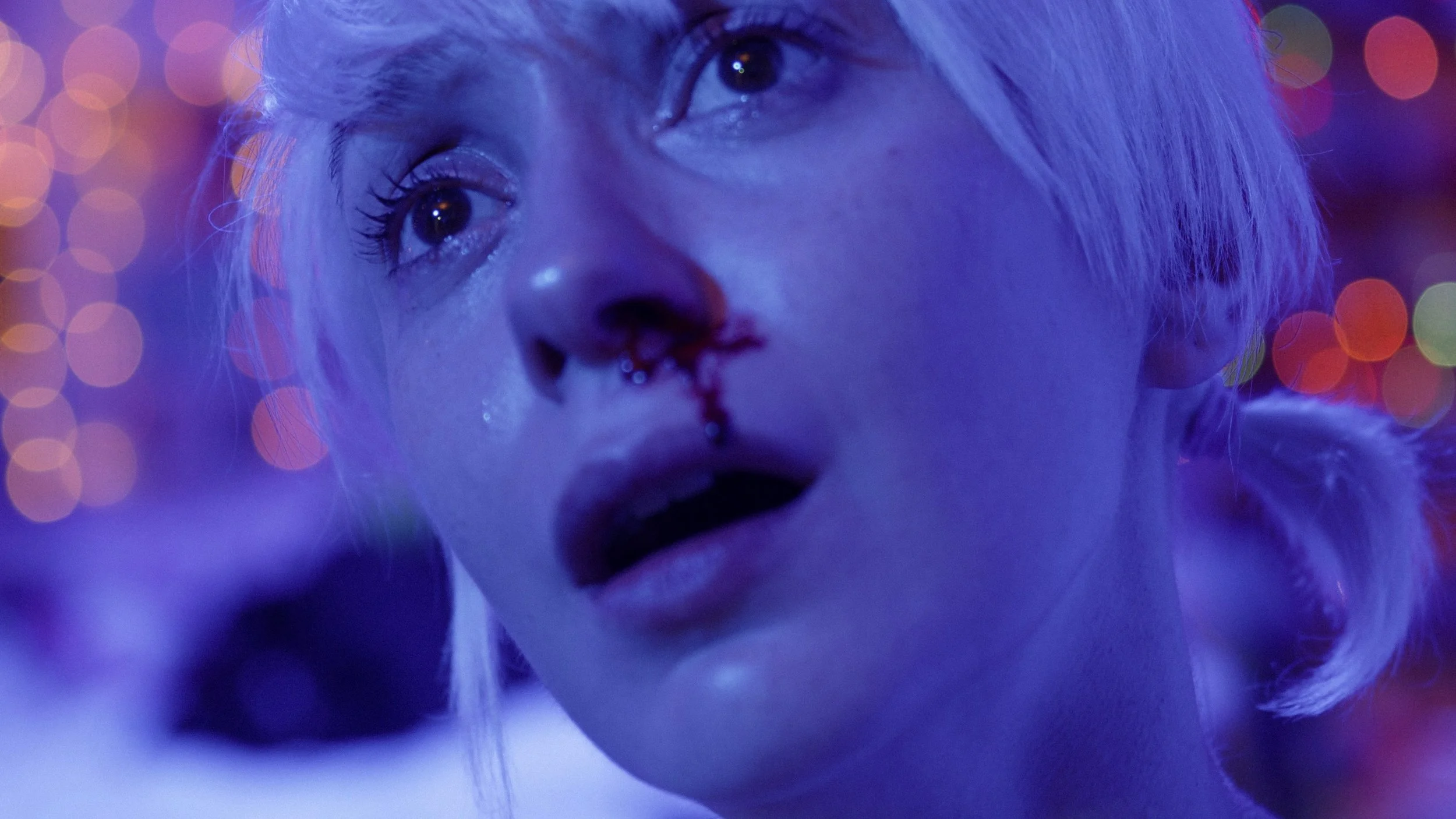
Make no mistake, Hag is definitely a Jackie Kelly rodeo. She takes on the major positions in its creation and is a force to be reckoned with. In front of the camera, the strongest aspect in her performance lies in her facial expressions. She displays a natural ability to show every kind of strong emotion imaginable through her looks and her demeanor. I caught wind of feelings of sorrow, innocence, forgiveness, fear, envy, and frustration. All this simply by any close-up the movie felt necessary to throw at me. Although talented in front of the camera, Jackie’s performance at times feels almost dangerous. One that might confuse make-believe with reality. When any actor cries or has a mental breakdown on screen, I don’t know how one can know if those feelings are real or not. It’s a tough spot to be in as a viewer. There is no doubt that Jackie Kelly’s dedication is immeasurable. I’ll leave it to the professionals. I just don’t want to see any actress end up like Isabelle Adjani after finishing Possession (1981).
Behind the camera is a filmmaker who comes across as innovative and playful. The comedy that Jackie Kelly finds in such a dark subject works for the right kind of audience. Its obsessive nature feels like a massive middle-finger to the Instagram algorithm that tells us how to live our lives if we want to be prosperous. The written dialogue feels real, relatable, and at times comes from a place of personal experience. When the verbal exchanges get intense, the camera moves closer to the faces in focus. Small things like this help show that Hag is very much character driven. It also makes some of the more abrasive scenes become all the more impactful. I mentioned that Jackie Kelly worked on Hag as the Writer, Director, and Producer; she also is remarkably the film’s Production and Wardrobe Designer. That’s a lot of talent bottled into one movie.
The rest of the crew behind the scenes is made up of a few names I recognize. Most prominently is veteran independent filmmaker Eric Stanze. I’ve followed Eric’s work for years, going all the way back to the year 1999 with his feature Ice from the Sun. He serves as the Editor, Cinematographer, Executive Producer, and Sound Designer on Hag. He also has a small role in the film. This got a few chuckles from the audience I was sitting with. Both Eric and Jackie previously worked together on In Memory of in 2018 and more recently a film titled Anxiety in 2024. Both of those features were directed by Eric. His work as the Editor on Hag stood out to me. His style displayed here feels noticeably measured and rhythmic, with many scenes and shots steadily put together in a way that carry much emotional weight. Logan Cole is credited for working on the Special Effects. I’m familiar with his work in Make-Up. If he worked on what I think he worked on in Hag, then he contributed to the creation of a big unforgettable character in the movie. I also want to mention Mando Franco who has a role as the “Bully” and also worked as a Production Assistant. He just released a feature called Reaper Road that premiered at Hysteria Fest alongside Hag.
The experience I had while watching Hag is one I will not soon forget. It’s not afraid to deliver a message we all worry about as we grow older and unapologetically does so hoping to leave a few marks. My biggest regret is not seeing it sooner when I had the chance. Luckily, it got another life at the St. Louis International Film Festival. Only watching it once does not feel like enough. An impressive directorial debut by Jackie Kelly. It’s strong violent content and subject matter might not be everyone’s thing. But for what it is and who it’s made for, it is a definite win. Fingers crossed for a physical media release. Hopefully a Blu-ray and one with the always appreciative Audio Commentary. I look forward to revisiting this one again soon.
